
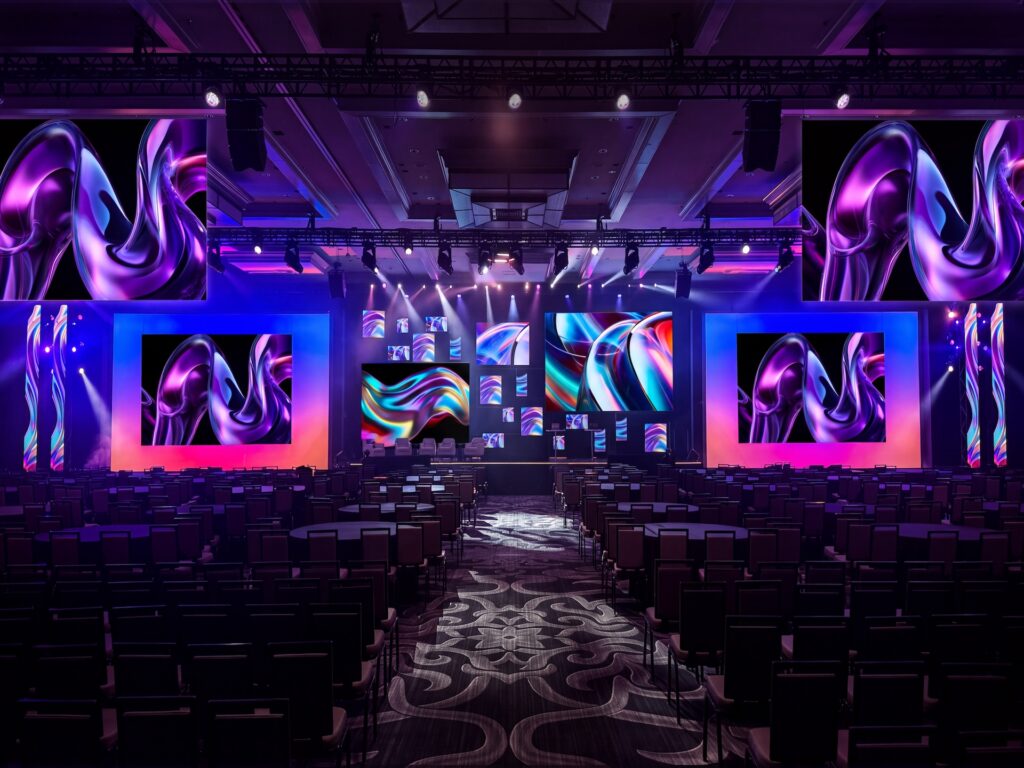
An event space rarely has just one job.
Over the course of a program, the same room may need to welcome attendees, support a general session, shift the energy for a new speaker or topic, transform for an evening experience, and then do it all again the next day. The best event space design considers those changes from the beginning, creating an environment that can adapt throughout the program. Instead of thinking about what a room should look like at one moment in time, we think about how it needs to work throughout the entire event.
Every venue comes with its own opportunities and limitations, and effective event space design starts with understanding how those factors shape what is possible. Ceiling heights change. Airwall tracks dictate where scenic elements can go. Rigging points, entrances, sightlines and room dimensions all influence what is possible. Understanding those details early allows the creative and production teams to design with the room rather than against it. That becomes especially important when a space needs to serve multiple purposes. Scenic elements can be designed to adapt. Screens and lighting can help define different areas or change the atmosphere. Thoughtful layouts can make transitions easier without requiring a complete room reset.
Sometimes the smartest design decision isn't adding something new. It's finding a better way to use what is already there.
Repeat programs offer an interesting creative challenge. The experience needs to feel fresh, but it also needs to remain recognizable.
Our ongoing work with Flavor Experience is a good example. For this client, that evolution happens through an ongoing collaboration with our in-house Creative Director, who understands both the brand and the history of the event. Each year, we look at the existing staging and ask where we can enhance it further, whether that means reimagining scenic elements, introducing new visual layers, or finding different ways to use familiar pieces within the space. That year-over-year partnership gives us the opportunity to build rather than restart. We know what has resonated, what needs to evolve, and where there is room to do something unexpected. The result is an environment that continues to feel distinctly Flavor while giving returning attendees something new to experience each year. That continuity gives the event its own visual identity while still leaving room to surprise attendees.
It also allows us to think further ahead. When you understand how a program operates, you can design scenic pieces and production elements with future flexibility in mind, considering how they might be reconfigured, repositioned or used differently as the event changes.
Not every transformation requires moving walls or rebuilding a stage. Motion graphics and digital content can completely shift the feeling of an environment without changing its physical footprint. Our Creative Brand Experience team uses content as another layer of the event design, helping screens become part of the atmosphere rather than simply places to display information.
A visual environment that feels energetic and bold during an opening session can become warmer and more understated later in the day. Content can reinforce a theme, support a transition or give different moments within the same room their own identity. When scenic, lighting and motion graphics are considered together, the room becomes much more versatile.
Room flips are often treated as something that happens between the important parts of an event. But those transitions can have a major impact on both the attendee experience and the production schedule. Planning for them early can reduce complicated resets and help the event maintain its momentum.
Can elements move easily? Does the lighting create a new environment while scenic remains in place? Will content transform the stage while attendees are at a break? Can one part of the room change while another remains active?
Those questions influence design decisions long before anyone walks through the doors. The goal is not simply to make a room easier to flip. It is to create an environment that was designed to change in the first place.
The same thinking extends outside the general session. Pre-function spaces, registration areas, corridors, lounges and networking spaces are all part of the attendee experience. When those areas are considered alongside the main room, the event begins to feel like one connected environment rather than a collection of separate spaces. That might mean carrying visual content into an arrival experience, creating flexible areas that support both networking and programming, or finding opportunities for attendees to engage with the event story as they move from one space to another.
The venue provides the footprint. What happens within it is where the opportunity begins.
Engaging event design isn't about filling every available corner or reinventing a room every few hours. It's about making intentional choices that give the event more possibilities. When creative, production and content teams are involved early, the conversation changes from What should the stage look like? to What does this space need to do? That question leads to better use of the venue, smoother transitions, more cohesive experiences and environments that can continue to evolve along with the event itself.
Because the most successful spaces aren't designed for a single moment. They're designed for everything the event needs to become.